Tuesday, June 7, 2016

Primary Colors: Does Political Affiliation Influence Car Color Choices?

CARS.COM - Today, voters in the nation's most-populous state will head to the polls for California's presidential primary. Democrats will decide between Hillary Clinton and Bernie Sanders, and Republicans between Donald Trump and, well ... also-rans. As they cast ballots according to their "red" or "blue" political affiliations, data shows they also may be inadvertently casting their car color vote.

Related: With Car Colors, Men and Women Don't See Eye to Eye

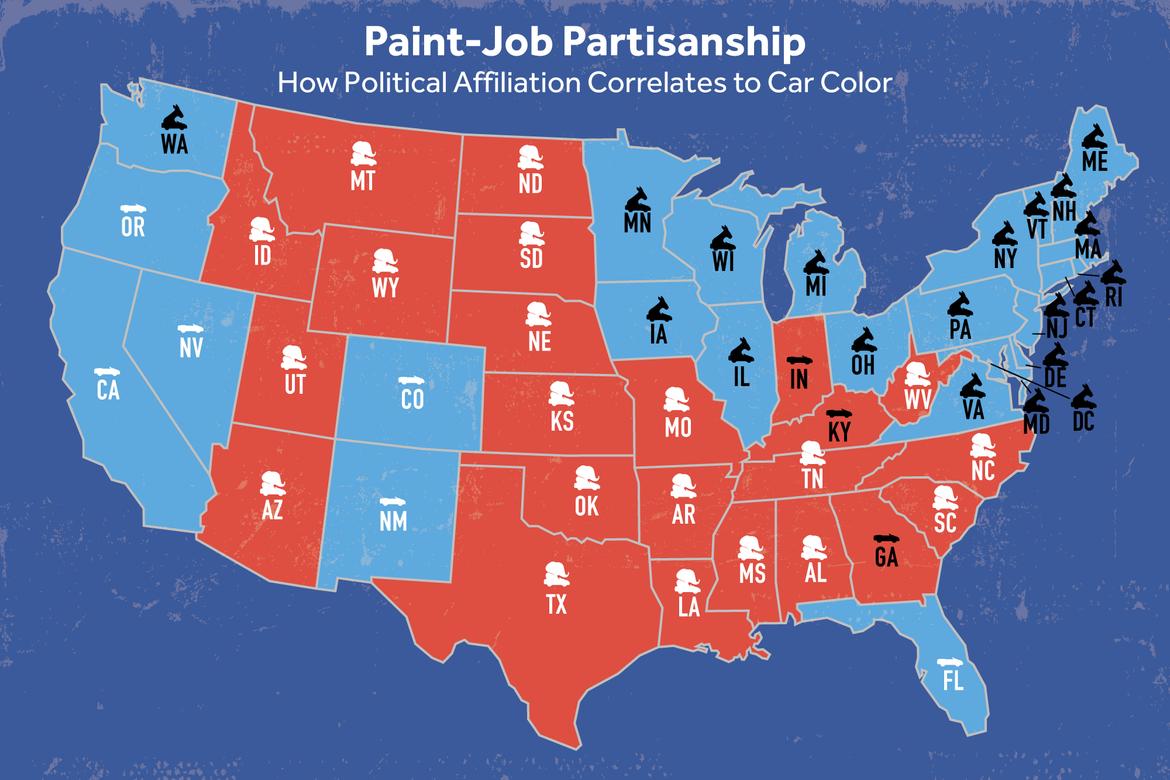
According to Cars.com's national database, the color people choose in red states and blue states is pretty much a black-and-white issue. Those in Democrat-voting blue states tend to buy black cars while drivers in Republican red states prefer white. Our data crunchers compared the most popular colors for higher-volume non-luxury vehicles in all 50 states against those states' voting records for the 2012 presidential election.


Political-Map_Dem_vs_Rep_map_3.2.jpg


Cars.com graphic by Paul Dolan


Of the 26 states that went blue the year President Barack Obama was elected to his second term, a decisive 19 (73 percent) tended to opt for black cars on the dealer lot. Meanwhile, the seven liberal-leaning states that preferred white cars tended to be in hotter, sunnier climates like California, Florida and Nevada - where the heat-absorption factor of darker colors is a serious consideration.

Republicans, meanwhile, showed an even stronger fervency for their paint color of choice, white - with a whopping 21 conservative-constituency states out of two dozen favoring the lighter side of the spectrum. That's nearly 88 percent among red states, with only Georgia, Indiana and Kentucky going black.

Among the Lower 48 states, irrespective of political partisanship, black-car states were overwhelmingly clustered in the Northeast and Midwest, with Georgia, Virginia and Washington the only exceptions. Meanwhile, excluding Iowa, Minnesota and Washington, every state west of the Mississippi was (to appropriate a phrase made popular by Texas native and self-styled Lincoln enthusiast Matthew McConaughey) all white, all white, all white.

Will California continue to buck the national trend as a blue state with white cars? We'll have to wait until election results start rolling in to get an idea of how the Golden State will go in terms of paint-job partisanship. In the meantime, we encourage all Americans to get out the vote, and vote the color of your conscience.

2017 Hyundai Elantra Eco: Real-World Fuel Economy

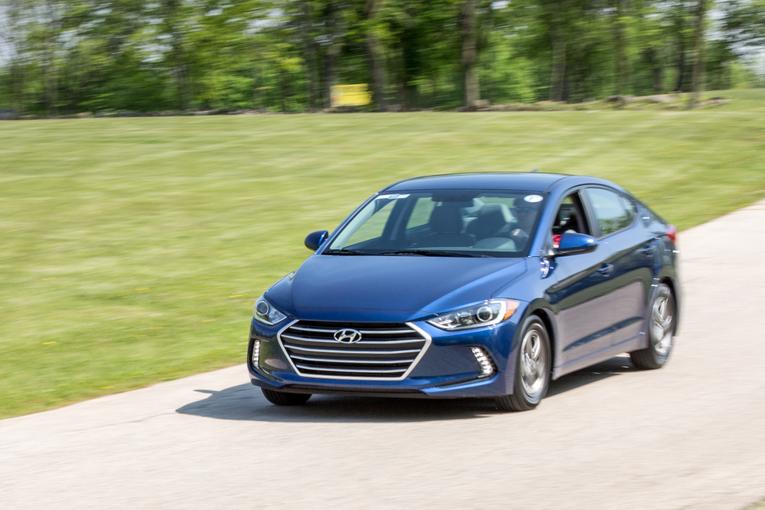
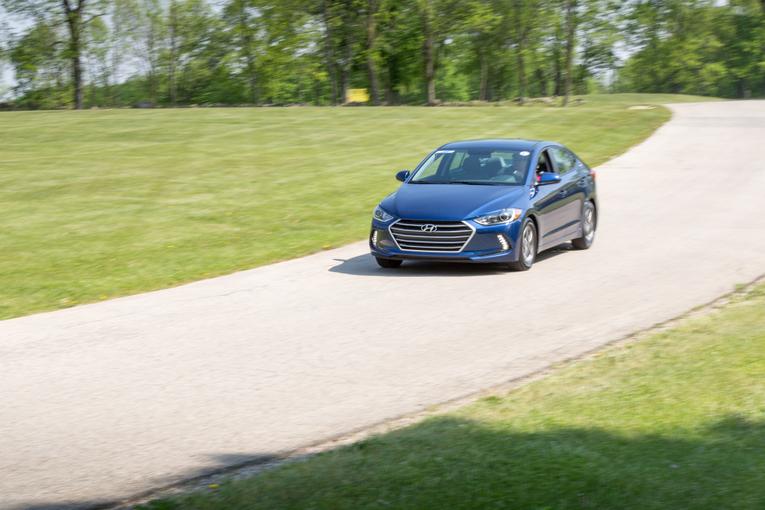
CARS.COM - Unlike the old days, when the cheapest version of a car gave you the best mileage, high-efficiency versions now typically cost more. The latest example is the Eco trim of the newly redesigned 2017 Hyundai Elantra. I spent a few days and a few hundred miles with this new gas-only sedan to see how it stacks up against the EPA estimates and its non-Eco brethren.

Related: 2017 Hyundai Elantra Review

Where the regular Elantra and its 2.0-liter non-turbo four-cylinder carries an EPA estimate of 28/37/32 mpg (city/highway/combined) with a conventional six-speed automatic transmission, the Eco is rated 32/40/35 mpg, endowed with a turbocharged 1.4-liter and a seven-speed, dual-clutch automated manual transmission. (The regular Elantra also offers a six-speed stick shift, but that's the least-efficient option, rated 26/36/29 mpg; times have changed.)

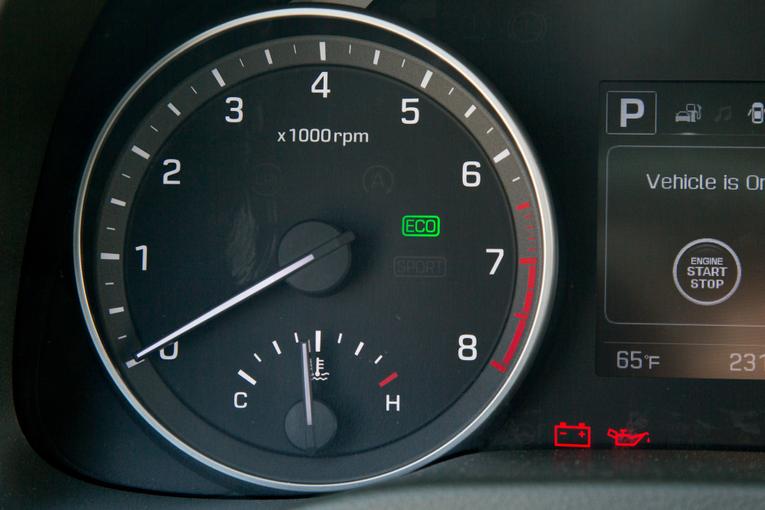
After my first trip, a continuous 147 miles, the trip computer said my little Eco achieved a stunning 49.8 mpg. It was a little hard to believe, honestly, but conditions were very good, if not optimal. I reset the computer and hopped right on the interstate where speeds never exceeded 70 mph and seldom dropped below 40 mph apart from a brief stretch of rush-hour congestion. The trip computer reported an average speed of 55 mph. The route was over mostly flat Midwestern terrain, with minimal wind and the air conditioning on but facing temperatures below 80 degrees. I had the drivetrain set to Eco mode most of the time, but in modern cars I've found these settings to have little effect in the kind of mundane driving I was doing.

For my return trip I topped off the tank as a backup to the trip computer and covered mostly the same ground in 139 miles. This time there were crosswinds and higher temperatures, and though the trip computer ultimately reported an average speed of 56 mph, there were sustained periods of both higher and lower speeds than I encountered on the first trip - both of which used more fuel. Upon arrival, the trip computer read 47.6 mpg. I refilled the tank, which took just 2.9 gallons for a calculated 47.8 mpg. The pump test isn't exceptionally accurate unless you can continue it over hundreds of miles and multiple fill-ups, but this result was pretty close, and still surprising.

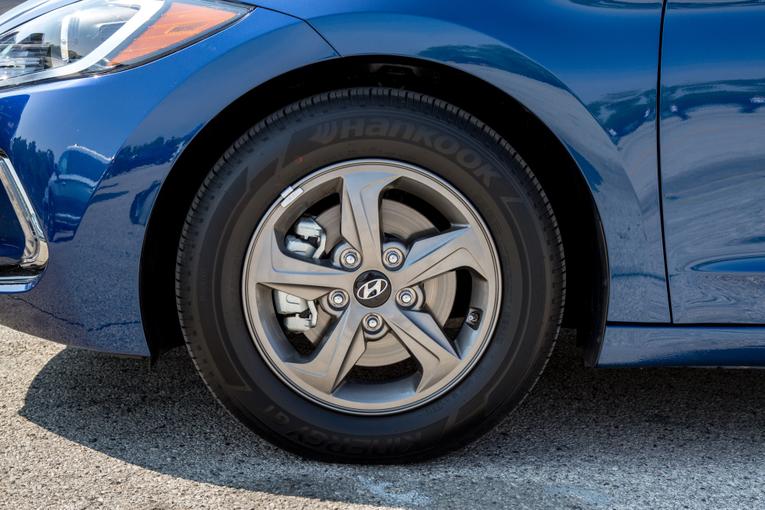
I convinced myself that the tires must be overinflated, which would explain both the mileage and the hard ride - notably hard for a car with an improved, reengineered suspension and regular (not run-flat) tires with uncommonly tall sidewalls on 15-inch wheels. Nope; I checked, and all four tires were 1 pounds per square inch below spec when cold.

The final test covered more than 130 miles of mixed driving over several days, with far more city duty - more stoplights and even higher heat. The trip computer reported 39.1 mpg and an average speed of 28 mph. This time around, the calculation came out to 34.0 mpg, a pretty big disparity between the two methods.

Even if the calculation is correct, the Elantra Eco beat the EPA combined number, an impressive showing. Mileage isn't merely about speed - it's about driving style, and Cars.com's hometown of Chicago and its associated suburban commutes demand more aggressive acceleration and inflict more of the type of transient slowdowns that gobble gas and provide no upside unless you're in a hybrid or electric. If you think you'll be doing more highway driving, the Eco has the old-school advantage. The most effective hybrids typically deliver better or equal mileage in city driving.

What's the sacrifice versus the regular Elantra? For one thing, it costs $21,485 including destination versus $17,985 for an SE, and it comes only with a base interior - one whose diminished quality compared with the previous generation has caused something of a revolt.

What you don't lose is much drivability. To the contrary, the seven speeds and 128 horsepower give the Eco some spirit compared with the 147-hp base engine. The Eco has 156 pounds-feet of torque at a low 1,400 rpm compared with the base 2.0-liter's 132 pounds-feet at 4,500 rpm. You definitely feel it.

Though this transmission gives me fits in some Hyundai applications - most notably the Tucson - it works well here, with minimal lag and only some awkwardness launching off the line. You feel it pulsing when creeping, as in a parking maneuver.

Now if they'd just give the option of the upgraded interior...


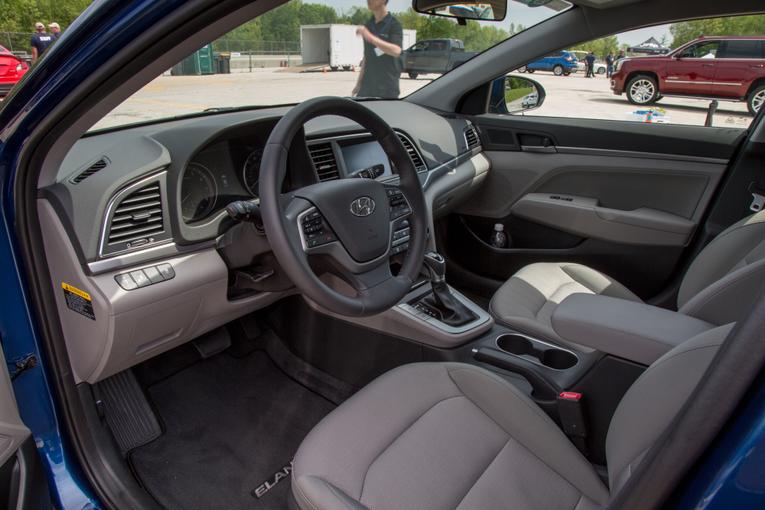
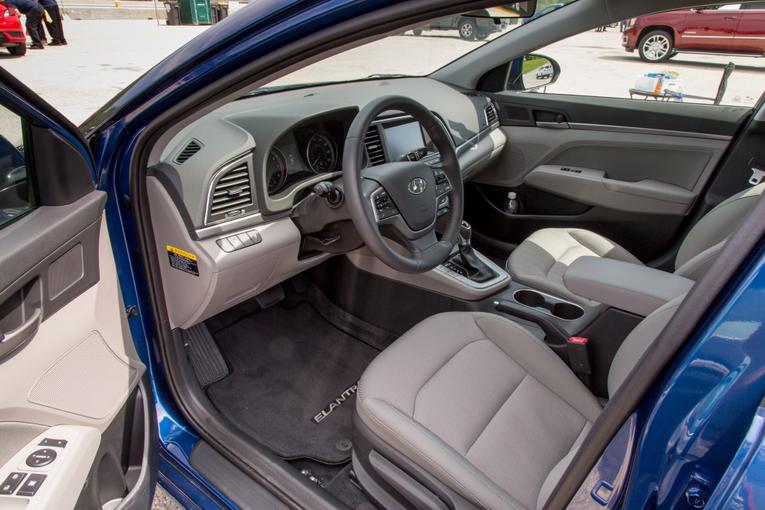
2017 Hyundai Elantra Eco


2017 Hyundai Elantra Eco


2017 Hyundai Elantra Eco


2017 Hyundai Elantra Eco


2017 Hyundai Elantra Eco


2017 Hyundai Elantra Eco


2017 Hyundai Elantra Eco


2017 Hyundai Elantra Eco


2017 Hyundai Elantra Eco


2017 Hyundai Elantra Eco


2017 Hyundai Elantra Eco


2017 Hyundai Elantra Eco


2016 Volkswagen Beetle Dune Video

CARS.COM - If you Google "Dune Buggy," what will likely pop up is Volkswagen's charming, '60s-era roadster: the knobby-tired, fender-flared sand-crawler. While the 2016 Beetle Dune isn't that, VW is trying to evoke a little bit of nostalgia with the Dune version, which is much more at home on the pavement but still turns heads - and looks like nothing else on the road.

Watch the video for more.

Analysts Boost Forecast for Autonomous Vehicle Sales

CARS.COM  - Citing a surge in autonomous vehicle technology, IHS Automotive has nearly doubled its forecast for sales of self-driving vehicles to almost 21 million overall by 2035.

Related: Automakers Work Toward Self-Driving Cars, Disagree on How to Get There

The business information provider sees annual sales of vehicles with true autonomous capability hitting 600,000 by 2025 and accelerating. As recently as 2014, IHS forecast about 12 million self-driving cars on the road by 2035. It also saw a preponderance of those having fully autonomous technology but still involving a driver at the wheel; it now sees growth beyond 2020 as more balanced between those vehicles with no driver required, according to Jeremy Carlson, principal analyst at IHS.

IHS said it raised its forecast based on increased research and development by automakers, auto suppliers and technology companies, as well as moves to make government regulation more supportive. "There are a lot of things coming together," said Carlson in a phone interview.

There has been a high-profile wave of activity recently by major automakers, including Fiat Chrysler Automobiles partnering with Google on a test fleet of self-driving Pacifica minivans. Toyota also recently announced an autonomous vehicle research facility in Ann Arbor, Mich., and Honda is testing autonomous vehicles in California.

Carlson sees new forms of autonomous vehicles in addition to traditional cars that may hasten adoption both of autonomous vehicles and electric power. Beyond the car ownership model, a service model providing mobility through ride-hailing with autonomous fleets of electric vehicles could make sense. "In a dense urban [area], you are seeing limitation and controls" on emissions and even access by private cars. "There can be a strong argument for providing mobility as a service," he said. To wit, GM has announced plans to develop a self-driving Chevrolet Bolt electric car for test use by car-hailing service Lyft, in which GM has invested.

But Carlson said much of the autonomous activity has been less visible in terms of work by industry suppliers. "Some of the bigger suppliers are developing and refining those capabilities," he said, adding automakers are ramping up their efforts in part because they have to work with those suppliers to successfully integrate their systems.

IHS cites continuing challenges, including the need for more changes in federal and state government regulation, and needed advances in software reliability and security from hacking. Shoppers have to be on board, too. To reach autonomous sales forecasts, automakers will also have to persuade consumers, who in recent surveys have demonstrated a wariness of the technology.

Progress is being made on the regulatory front, however. Federal safety regulators have pledged to do more to lower barriers, and the Obama administration has proposed $3.9 billion in new spending over the next decade to fund projects that accelerate the research toward and sale of self-driving cars. And some states, including Michigan, California and Nevada, have moved to create a regulatory environment that fosters development.

Monday, June 6, 2016

2017 Volvo S90 First Drive: Sleek, Sophisticated, and Not a BMW

2017-Volvo-S90-PLACEMENT
-After Ford sold Volvo to Chinese automaker Geely in 2010, the Swedish company's first order of business was to fashion a new product lineup that would update its aging fleet of vehicles and catch up to the other luxury brands, which were surging. Geely had plenty of money to invest in Volvo, but even so, the automaker had to plan this new portfolio around flexible engines and platforms that could be widely used in a brand with barely half a million global sales in 2015. We saw the first vehicle to emerge from this process last year, the new XC90 three-row SUV. This new S90 luxury sedan is the second new product of the Geely era. READ MORE ››

-

Friday, June 3, 2016

2017 Nissan GT-R First Drive: Godzilla Learns Some Manners

2017-Nissan-GT-R-PLACEMENT
-For the source of the Nissan GT-R's bad-boy nickname, look to Honda-Ishirō Honda. In 1954, that Japanese film director conceived Gojira, the monster born of World War II nuclear radiation that we know as Godzilla. After this icon wreaked havoc in 30 films, the name was a natural fit for Nissan's sports coupe, which evolved through six generations before arriving here as the 2009 GT-R. Now the seventh generation is about to face that nicer road monster of Honda's making: the new Acura NSX. READ MORE ››

-

Tesla's Musk Takes Blame for Model X Woes, Announces Door Fix

CARS.COM - Tesla CEO Elon Musk has taken full responsibility for the spate of problems involving the company's latest product, the Model X, saying he tried to put too much new technology into the vehicle at launch.

Related: Tesla Boosts Range, Power and Price of Model X

Owners have had to deal with quality issues, including trim fit and finish, and frozen touch-screens, as well as a recall in April to replace rear seats that failed a strength test in Europe. But the problems getting the most attention have been with the operation of the Model X's signature Falcon Wing doors, gull-wing rear doors that would sometimes not open when intended, would open when not intended and would fail to sense a low ceiling or tight parking space.

"I need to fault myself for a little bit of hubris for putting too much technology all at once into a product," said Musk, speaking at the Tesla annual shareholder meeting this week at the Computer History Museum in Mountain View, Calif. "In retrospect, the right thing to do with the Model X would have been to take a lot of the really awesome, cool things but kind of table them ... for Version 2 and Version 3 instead of piling all of them in Version 1."

Regarding the doors, Musk said that "getting the complex set of sensors to work well has been incredibly difficult to refine. I think we're almost there in making the doors useful.

"It's a software problem. It's figuring out, how do you interpret all the information from the sensors? What should you remember? What shouldn't you remember? How should you open the door in different circumstances, if you're in a low ceiling or a narrow situation? If the sensor is giving erroneous feedback, when is the right time to ignore the sensor?

"... Digging ourselves out of the hole has been quite, quite hard," he added.

Musk promised that over-the-air software updates now and "in about a month" will get the doors right.

"Finally we'll be at the point where the doors are better than normal doors, as opposed to worse," he said, adding, "If you order a Model X now or soon, trust me, you will love the doors because the software will actually be right."

Musk also used the shareholder meeting at the museum for a long and detailed look at the history of Tesla Motors. For more, watch the video of Musk's presentation, here.